Electric Vs. Pneumatic Gripper For High-Mix Machine Tending: What Actually Works?


On This Page
- 1. What Makes High-Mix CNC Tending Different?
- a. Part Variety
- b. Changeover Efficiency
- 2. Pneumatic Grippers In High-mix CNC Machine Tending
- a. Strengths Of Pneumatic Grippers
- b. Limitations in High-Mix Applications
- 3. Electric Grippers: Flexibility Through Software
- a. Strengths Of Electric Grippers
- b. Limitations in High-Mix Applications
- 4. Pneumatic vs. Electric Gripper: At a Glance
- 5. Gripper for High-Mix Machine Tending: Which One Actually Works?
- Quick Decision Framework
- 6. Where SusGrip fits in this picture
- Conclusion
Key Takeaway
- In high-mix CNC machine tending, the gripper is configured once for a dedicated line - but must adapt continuously across part variants and job changeovers.
- Pneumatic grippers offer high force and fast actuation, but require mechanical adjustment when part geometry changes - adding setup time and operator involvement at every changeover.
- Electric grippers handle part variety through software without touching the tooling. This is where they have a real operational advantage in high-mix
In high-mix CNC machine tending, the gripper is often the last thing specified and the first thing that causes problems. Part geometry changes between jobs, changeovers happen frequently, and the tooling that worked perfectly for one batch may not reliably handle the next.
Pneumatic and electric grippers approach these challenges differently. This article examines how each performs under the actual conditions of high-mix production - where their limitations appear, and which factors should drive the selection decision.
1. What Makes High-Mix CNC Tending Different?
Dedicated machine tending cells are typically optimized for a small number of workpieces with stable production volumes. Once the gripper is configured, the cell can run for extended periods with minimal adjustment.
High-mix production introduces a different set of requirements. A single cell may need to handle dozens of part variants across frequent job changeovers, while maintaining throughput and minimizing unplanned downtime.
In high-mix environments, two additional factors determine whether a gripper is the right fit for the cell.
a. Part Variety
In high-mix tending, the gripper must cover a wide range of workpiece dimensions, geometries, and gripping surfaces - often within the same shift. The relevant question is whether a single gripper configuration can accommodate the required part range, or whether the application requires multiple specialized tools.
b. Changeover Efficiency
Each job switch in a high-mix cell represents a period where the spindle is stopped and the cell is not producing. If the gripper requires mechanical adjustment, fingertip replacement, or re-teaching for each new part, that time accumulates quickly across a production week.
For a broader look at how gripper choice affects machine tending outcomes, see Automating Machine Tending: Why the Right Cobot Gripper Matters.
2. Pneumatic Grippers In High-mix CNC Machine Tending
Pneumatic grippers have been the standard in machine tending for decades, and their advantages in the right context are genuine.
Strengths of Pneumatic Gripper
- High gripping force in compact form factor
- Compressed air usually already on-site
- Custom fingers easy to fabricate in-house
- Fast open/close for short cycle times
- Mechanically simple – proven reliability
- Lower upfront purchase cost
Limitations of Pneumatic Gripper
- Finger swap / jaw adjustment at every changeover
- Changeover labor accumulates across the week
- Spindle stops each time tooling is reconfigured
- No built-in grip feedback for lights-out ops
a. Strengths Of Pneumatic Grippers
- High gripping force: In machining environments, grip force matters. Metal parts are heavy, rigid, and need to be held securely during the load/unload sequence. Pneumatic grippers deliver high clamping force in a compact form factor - typically far more force per unit size than electric alternatives.
- Infrastructure Availability: In most manufacturing facilities, compressed air supply is already part of the existing plant infrastructure. Adding a pneumatic gripper to an existing cell typically requires only a connection to the air supply line - without additional capital equipment or significant integration effort.
- Ease of Custom Tooling: Pneumatic finger tooling is relatively straightforward to fabricate in-house. Custom fingers and jaw inserts can be produced without specialized equipment or advanced technical knowledge, allowing facilities to adapt tooling for specific workpieces without external vendor involvement.
- Fast actuation: Compressed air enables rapid opening and closing motions, supporting short machine tending cycle times.
- Proven industrial reliability: Pneumatic systems are mechanically simple - fewer components to fail, well-understood maintenance, and a long track record in industrial environments.
- Lower upfront cost: The initial purchase price of a pneumatic gripper is typically lower than that of a comparable electric solution.
For dedicated production lines with stable workpiece geometry, these advantages make pneumatic grippers difficult to justify replacing.

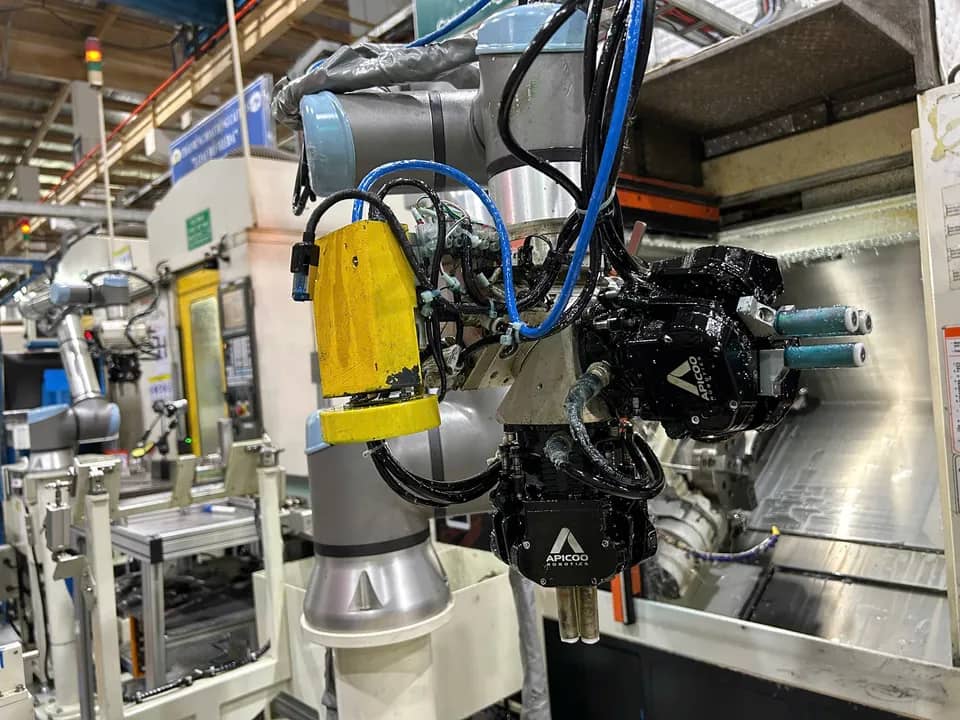
Pneumatic 3-jaw gripper in a machine tending application.
b. Limitations in High-Mix Applications
In practice, pneumatic grippers introduce a set of constraints that become increasingly difficult to manage as part variety and changeover frequency increase.
- Limited Adaptability: Pneumatic grippers are typically configured for a specific workpiece or part family. When part geometry changes significantly, tooling modifications such as finger replacement or jaw adjustments are often required, increasing setup effort and changeover time.
- Hidden Cost: Frequent tooling changes require operator or engineering involvement to reconfigure and validate the setup. When changeovers occur regularly, the associated labor and engineering effort can become a meaningful operational cost. Beyond labor, each reconfiguration also means the machine is stopped and not producing. In high-mix production, that accumulated downtime is a direct reduction in cell output that rarely appears in the initial cost comparison.
- No Built-In Grip Feedback: Without additional sensing hardware, the controller cannot reliably verify whether a part has been successfully gripped before the robot moves. This can be a limitation in unattended or lights-out operation.
3. Electric Grippers: Flexibility Through Software
Strengths of Electric Gripper
- Recipe-based changeover – no hardware touch
- Wide stroke covers large part variety
- Built-in grip verification for unattended runs
- 24V DC only – no pneumatic infrastructure
- Plug & play, no coding required
- No homing needed after power-on
Limitations of Electric Gripper
- Lower max force – verify for heavy castings
- Sensitive to coolant mist – check IP rating
- Higher upfront cost than pneumatic
a. Strengths Of Electric Grippers
Electric grippers address the flexibility requirements of high-mix production through software-configurable operation rather than mechanical adjustment.
- Faster Changeovers: Gripping parameters - stroke, force, and speed - are stored as predefined recipes per workpiece. When a job changes, the controller loads a new recipe rather than requiring mechanical adjustment to the tooling, reducing changeover time and operator intervention.
- Wider Operating Range: Electric grippers offer a longer stroke and adjustable force range compared to pneumatic alternatives. A single gripper can open wide enough for large parts and close with controlled force on smaller or more delicate workpieces - without fingertip changes. For example, in one CNC machine tending deployment of Apicoo Robotics, a single SusGrip-3F handled 43 SKUs across a 25–157mm size range through software configuration rather than tooling changes.
- Built-In Grip Verification: Position feedback is integrated into the gripper. This allows the controller to verify successful gripping before the robot moves, improving process reliability and supporting unattended operation.
- Simplified Infrastructure: Electric grippers run on standard 24V DC power and require no compressed air supply or supporting pneumatic infrastructure. This reduces installation complexity and makes deployment more straightforward, particularly in facilities where compressed air availability varies across the production floor.
b. Limitations in High-Mix Applications
No gripper for high-mix CNC machine tending eliminates every trade-off. Electric grippers address the flexibility requirements of high-mix production effectively, but two limitations are worth evaluating before committing to a specific model.
- Force Limitations: Electric grippers typically provide lower maximum gripping force than pneumatic alternatives. For heavier workpieces, engineers should verify that the selected gripper can provide sufficient force with an appropriate safety margin.
- Environmental Sensitivity: Electric grippers contain components such as motors, encoders, and circuit boards, that are sensitive to coolant mist, metal chips, and moisture common in CNC environments. Without an adequate IP rating, these components are exposed to conditions that can affect long-term reliability.
- Higher Initial Cost: The flexibility and sensing capabilities of electric grippers come at a higher upfront cost compared to pneumatic solutions.
Read more: Exploring Different Types Of Robotic Grippers In Manufacturing
4. Pneumatic vs. Electric Gripper: At a Glance
Criteria | Pneumatic | Electric |
|---|---|---|
Grip Force | High | Moderate - up to 100N |
Changeover | Mechanical | Software-only |
Part Range | Limited | Wide |
Grip Verification | None built-in - needs add-on sensors | Integrated |
Infrastructure | Compressed air | 24V DC only |
Lights-Out Ready | Limited | Yes, built-in verification |
Upfront Cost | Lower | Higher |
Best For | Stable, dedicated lines; heavy parts | High-mix, frequent changeovers, unattended ops |
5. Gripper for High-Mix Machine Tending: Which One Actually Works?
In high-mix machine tending, electric grippers tend to be the more practical choice - not because they are inherently superior, but because their flexibility aligns with what the application actually demands. Software-configurable stroke, force, and speed mean the gripper adapts to the next job through a parameter change rather than a hardware adjustment, which directly reduces the changeover burden that defines high-mix production.

That said, workpiece weight remains a real constraint. Electric grippers have a lower force ceiling than pneumatic alternatives. If your mix includes heavy castings, large billets, or dense metal blocks where grip force margins are tight, verify the payload rating against your heaviest workpiece - with a safety margin, not at the limit. In those cases, pneumatic grippers remain the more reliable option.
Quick Decision Framework
Question | Recommendation |
|---|---|
Parts are heavy castings or large billets (>5 kg)? | Pneumatic gripper |
Changeovers happen daily or multiple times per shift? | Electric gripper |
Need lights-out or unattended operation? | Electric gripper |
Cell runs a stable, fixed part family (low-mix)? | Pneumatic gripper |
Need to cover 10+ SKUs with a single gripper? | Electric gripper |
Minimizing upfront hardware cost is the priority? | Pneumatic gripper |
6. Where SusGrip fits in this picture
SusGrip is Apicoo Robotics' electric smart gripper series, designed for automation environments where part variety is high and reconfiguration needs to be fast.
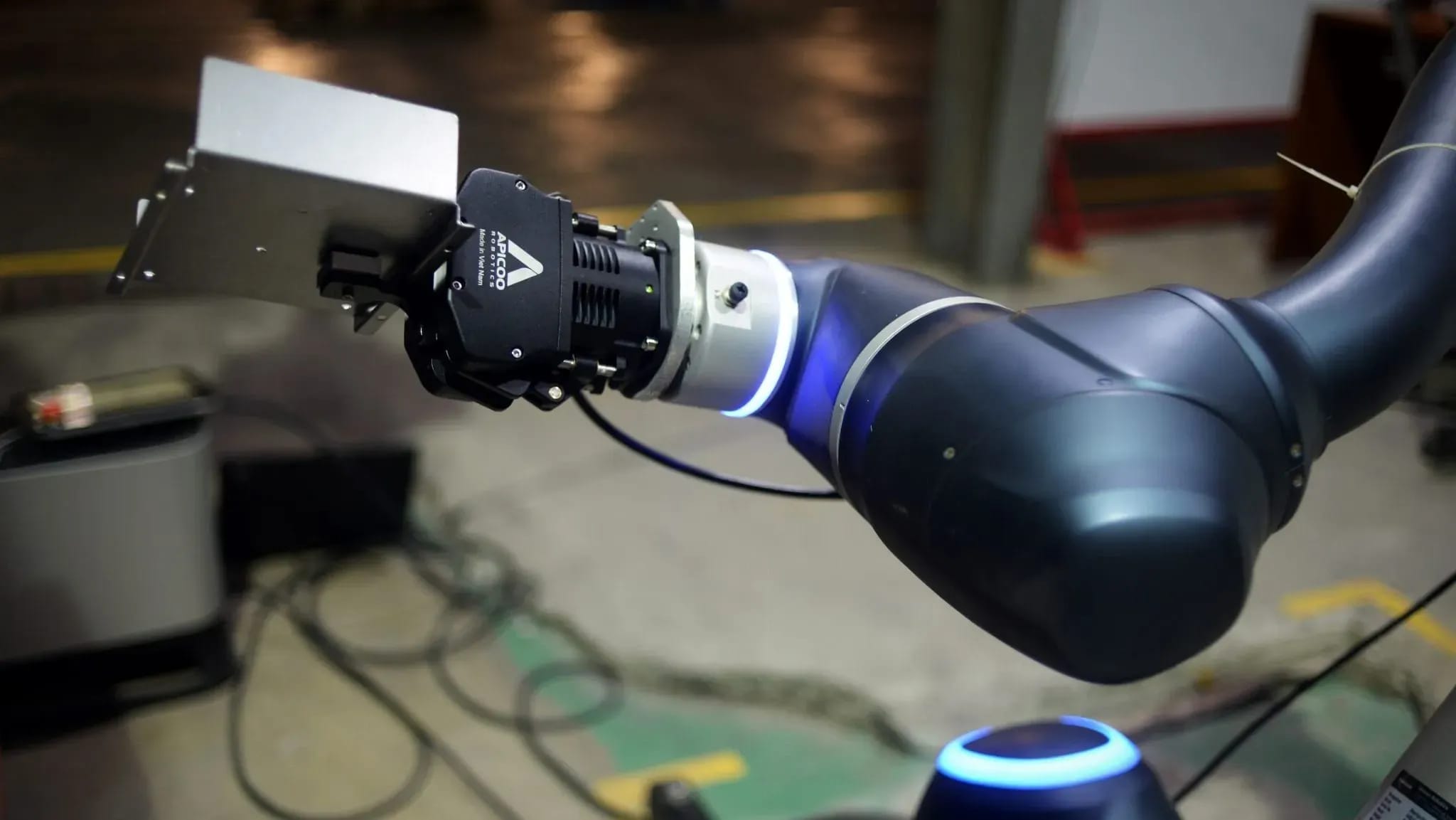
The product family includes the SusGrip-2F parallel gripper and the SusGrip-3F concentric gripper, both rated for a 5 kg payload and up to 140 N of gripping force. SusGrip electric gripper handling mixed components without tooling changes.

Several capabilities are particularly relevant in high-mix production environments:
- Wide Part Coverage: With a long stroke in a compact body, a single gripper can accommodate a broad range of workpiece sizes without frequent tooling changes.
- Built-In Grip Verification: Integrated object detection confirms part presence before the robot proceeds to the next operation, improving process reliability in unattended applications.
- Reduced Setup Effort: Plug & play installation with no coding required - gripping parameters are configured through an intuitive GUI and can be adjusted between jobs without programming. Position encoding eliminates the need for homing or calibration during startup, so the gripper is ready to run immediately after power-on.
- Flexible Workpiece Handling: Internal and external gripping modes, combined with customizable fingertips, enable a single gripper to support multiple part families within the same cell.
- Simplified Integration: Native compatibility with UR, JAKA, Techman, Agile Robots, Doosan, and FANUC CRX reduces deployment effort across different robot platforms.
Conclusion
Both pneumatic and electric grippers have a place in machine tending. The right choice depends on the requirements of the application rather than the technology itself.
For high-mix machine tending, however, the priorities often extend beyond gripping force alone. Frequent changeovers, a wide range of part variants, and the need for reliable unattended operation place greater emphasis on flexibility, process visibility, and ease of deployment.
These are the areas where electric grippers can provide meaningful operational advantages.
If you are evaluating a gripper for high-mix machine tending, SusGrip is available for a 35-day free trial. Contact us to discuss your application and explore whether it is the right fit for your production requirements.