High-Mix, Low-Volume Manufacturing: Why It Is Growing and What It Means for Automation


On This Page
- What HMLV Means: Same Volume, Divided
- HMLV vs. High-Volume Production: What Actually Changes
- What Is Driving the Shift to HMLV
- 1. More Customization
- 2. Shorter Product Life Cycles
- 3. Shorter Lead Time and Lower Inventory
- 4. Skilled Labor Is Scarce and Expensive
- 5. Supply-Chain Resilience
- What Makes HMLV Automation Possible
- 1. Cobots Make Automation More Viable for Short Runs
- 2. Robot Job Changes Need Less Programming
- 3. Digital Planning and Connectivity
- 4. Vision and Sensing Handle Part Variation
- 5. Grippers Can Adapt to the Part Instead of Being Swapped
- The Next Step: Humanoids
- What HMLV Automation Needs From the Gripper
- Reach buys size, control buys difficulty
- Where SusGrip Fits
- In Practice: Sumitomo's CNC Line
- Conclusion
Lines and cells that were designed around long, stable runs of one part number are now expected to handle a growing range of variants. Each switch means a changeover: a new program, different fixtures or gripper fingers, a first-part check, and time the machine is not producing. Manufacturers in machining, electronics, medical devices and packaging are seeing the same shift.
This is high-mix, low-volume (HMLV) manufacturing. It is not a new production model, but it is spreading into plants that were built around long, stable runs. In this article, we explain what HMLV means, why manufacturers are moving toward it, what is driving the automation of HMLV production, and what that automation needs from the gripper.
Key Takeaway
- HMLV is growing because customization and shorter product life cycles create more variants, while inventory and lead-time pressure turn them into small, frequent batches.
- Dedicated automation rarely pays back on that kind of production, and skilled labor to run it by hand is getting scarcer and more expensive.
- Cobots, stored job settings and vision now let one cell switch between parts with less engineering work.
- The gripper often decides whether that flexibility pays off: it needs the reach and control to cover the whole part family without finger changes.
What HMLV Means: Same Volume, Divided
High-mix, low-volume (HMLV) manufacturing means producing a wide range of products or part variants, each in relatively low volume. The same production line or cell may handle many of these variants and switch between them frequently. The defining feature is not necessarily lower total output, but how that output is spread across variants.
For example, a cell that used to produce one part number all year may now produce several related part numbers, each in much smaller quantities. Total output may stay similar, but smaller quantities per part number usually mean smaller batches and more frequent changeovers. The volume is the same; it is simply divided across more part numbers.

llustrative: with total volume held constant, more part numbers mean less volume per part number.
Aerospace, medical devices and electronics manufacturing services have long been HMLV environments. The change is most noticeable in plants built for long production runs, which now have to handle more variants without multiplying equipment, tooling and setup work.
HMLV vs. High-Volume Production: What Actually Changes
Moving from low-mix, high-volume production toward HMLV changes what a production system must optimize. In high-volume production, the priority is often maximizing throughput and reducing unit cost across long runs. In HMLV, the ability to switch between products quickly and economically becomes equally important.
Low-mix, high-volume | High-mix, low-volume | |
Optimized for | Low cost per unit at scale | Speed and cost of each changeover |
Product variety | Few variants, stable for years | Many variants, changing continuously |
Batch size | Large, continuous runs | Small, from one to a few hundred |
Equipment | Dedicated, fixed | Multi-purpose, reconfigurable |
Changeovers | Infrequent; hours to days of downtime accepted | Frequent; measured in minutes |
Programming | Programs remain stable over long runs | Programs and parameters may need frequent updates |
Labor | Repetitive tasks with established procedures | More setup, troubleshooting, and variant-specific work |
Inventory | Make-to-stock, high finished-goods stock | Make-to-order, low stock |
Typical sectors | Automotive body and powertrain, high-volume packaging | Aerospace, medical devices, electronics manufacturing services (EMS), contract machining |
The practical consequence is that changeover time has a different economic impact. In a long production run, a 30-minute changeover is spread across many hours or days of production. In HMLV, the same changeover may recur several times per shift. Equipment that runs quickly but takes a long time to switch between products can therefore deliver less effective output than its cycle time suggests.

Illustrative: One machine, one week: production time lost to changeovers in low-mix vs. high-mix
What Is Driving the Shift to HMLV
Several market and production trends are changing how manufacturers distribute production across product variants. More customization increases the number of variants; shorter product life cycles reduce the time each variant remains stable; and pressure to respond faster makes large, infrequent production runs harder to sustain. At the same time, labor shortages and supply-chain shifts make that kind of production harder to run by hand.
1. More Customization
Both consumer and industrial buyers increasingly expect products configured for their needs. Different specifications, dimensions, materials and features create more variants, spreading demand across a wider range of part numbers.
The result is a longer tail of products, each requiring only a small production run.

Illustrative: Three common options turn one base part into 18 part numbers, each with a share of the original demand.
2. Shorter Product Life Cycles
In sectors such as electronics and electric vehicles, product designs and specifications change rapidly. A part may move from an initial production run to a revised version or replacement before it has accumulated years of stable demand.
Each revision creates a new production requirement and shortens the time available to produce any one version at scale. Across a year, manufacturers handle more product changes and shorter runs instead of one stable, high-volume configuration.
3. Shorter Lead Time and Lower Inventory
More variants alone do not force small batches. To meet short lead times, a plant can produce each variant in a large lot and ship from stock. But finished goods tie up working capital and risk becoming obsolete when designs change. As the product mix grows, keeping enough stock to cover every variant becomes increasingly expensive.
The alternative is to produce closer to demand, often through make-to-order: smaller batches run more frequently as orders arrive. This reduces reliance on finished-goods inventory, but every switch to a different variant adds a changeover. The more varied the orders, the more important fast, economical changeovers become.

Illustrative: Make-to-stock means fewer changeovers but more stock. Make-to-order means less stock but more changeovers.
4. Skilled Labor Is Scarce and Expensive
HMLV production often relies on skilled operators who can switch between parts, adjust setups and resolve problems quickly. These workers are getting harder to find. Deloitte and The Manufacturing Institute estimate that US manufacturing could need as many as 3.8 million additional workers between 2024 and 2033, with around 1.9 million jobs going unfilled. Aging workforces add to the pressure in Japan, Korea and much of Europe.
5. Supply-Chain Resilience
To make supply chains more resilient, manufacturers are moving production closer to their customers through reshoring and nearshoring. Production moving back to the US and Europe lands where, by the Reshoring Initiative's estimate, overall manufacturing costs run 10–50% higher than offshore alternatives. Those plants also compete for a limited pool of skilled workers, strengthening the case for automating labor-intensive tasks.
What Makes HMLV Automation Possible
Robots have been on factory floors for decades, but traditional automation is built to pay back at scale, so much HMLV work has stayed manual. Advances in robots, software, vision and grippers now make automation practical for that work too.
1. Cobots Make Automation More Viable for Short Runs
Traditional fixed automation is built around a specific part, with dedicated fixtures, grippers and programs. That investment pays back through volume, which works when one part runs for months.
In HMLV, volume is spread across many part numbers, making it harder to justify a dedicated setup for each one. Many HMLV tasks have stayed manual for that reason. Swapping tooling between parts also adds downtime at every changeover.
Collaborative robots change part of that equation. They take up less floor space than conventional fenced cells and can work alongside people in suitable applications when the required risk assessment and safeguards are in place. The same robot can serve several part numbers or move to a different task as the production mix changes, spreading its cost across more work.
2. Robot Job Changes Need Less Programming
Reusing a robot across multiple part numbers only pays off if switching between jobs is practical. Robot software reduces the engineering work involved in each transition.
Robot programs and process parameters can be stored by job and loaded when production switches to another variant, rather than entered from scratch. Simulation lets engineers prepare and check new programs offline.
These tools reduce programming and setup work, but they do not eliminate physical changeover tasks such as changing fixtures, loading material or inspecting the first part.
3. Digital Planning and Connectivity
Frequent changeovers also put more load on planning. Manufacturing execution systems (MES) can coordinate which job runs next and send the relevant program number, parameters and work instructions to the cell, instead of an operator setting each one by hand. Scheduling tools can sequence jobs so that similar variants run back to back, which keeps each changeover smaller. Standard industrial interfaces let the machine, robot and gripper receive job data and report their status, so a job change can be triggered and confirmed across the cell.
4. Vision and Sensing Handle Part Variation
Machine vision identifies parts and estimates their positions, allowing a robot to adapt its motion to where a part is actually located. In applications where vision can accommodate variation in part position and presentation, it reduces the need for precision fixtures and makes it easier to handle multiple variants on the same cell.
Further ahead, learning from demonstration and AI models trained on robot data aim to let robots handle unfamiliar parts and tasks with less explicit programming. Their reliability across varied factory environments is still developing, so these methods remain an emerging capability rather than a general-purpose solution for HMLV production.
Our own pick-and-place test with mixed objects, still a work in progress, shows one early form of this: vision identifies each object and sets the gripper’s opening, force and speed before the pick.
5. Grippers Can Adapt to the Part Instead of Being Swapped
A robot can switch programs quickly, but if its gripper cannot handle the next part, the cell still needs a hardware change: new fingers, a different tool or manual intervention. The gripper is therefore a physical condition for the cell's flexibility to pay off.
A gripper with sufficient stroke and suitable contact geometry can handle multiple part variants without changing hardware. Programmable electric grippers can store position, force and speed settings for each job, while feedback helps the cell check whether the grip reached the expected position. Together, these capabilities can turn a hardware changeover into a program change for applications within the gripper's working range. We look at what this requires in practice later in this article.

Illustrative: When the next part is within the gripper’s range, a part change becomes a parameter change instead of a hardware change.
The Next Step: Humanoids
Humanoid robots could extend flexible automation beyond individual processes to multiple stations and tasks, handling different objects and operations across a workspace. But factory deployment at scale remains a future prospect, not an established HMLV solution today.’

SusGrip-2F mounted on a dual-arm humanoid platform during testing.
For a closer look at how end effectors are evolving for humanoids, see our article on Grippers vs. Dexterous Hands for Industrial Humanoid Robots.
What HMLV Automation Needs From the Gripper
A robot program can be switched without touching hardware. If the gripper still has to be changed for every part group, each switch means stopping the cell, adding setup work and bringing back the downtime automation was meant to remove.
In HMLV, where a station moves between many part numbers, that happens often. So a gripper has to be judged differently: count the family, not the part. What matters is not just whether it can handle a given part, but how many of the part numbers in the family one setup can handle.
Reach buys size, control buys difficulty
Covering a part family takes two things from one gripper setup. Neither is a single specification; each is the result of several design choices working together.
- Reach is the range of parts one setup can grip without a finger change, from the smallest part in the family to the largest. Stroke sets the outer limit, but finger and fingertip design decide how much of it is usable: whether the fingers can grip from outside or inside, and whether they make stable contact at both ends of the range. Every part that falls outside the reach brings back a finger change, and with it the downtime the cell was meant to avoid.
- Control is the range of gripping conditions one setup can handle, from parts held in a fixture to parts that are oily, delicate or loosely positioned. It depends on setting force, position and speed for each part, on fingertip contact that holds the part without slipping or marking it, and on feedback that helps confirm the grip state before the robot moves on. Jaw motion also matters: angular and pivoting jaws change their contact angle as the opening changes, while parallel jaws keep it constant across the size range.

Reach covers the range of part sizes; control covers the range of gripping conditions. One setup covers the family only when it has both. Illustrative.
A gripper with sufficient reach but inadequate control may fit every part yet fail to hold some reliably. A gripper with precise control but limited reach still needs a finger change when a part falls outside its range. Either limitation can force a tooling change or return the task to manual handling. Covering the family requires both.
Reach and control are only part of gripper selection. Payload and gripper weight, sealing against coolant and chips, and behavior at power-on also affect suitability for production.
- For the full set of selection criteria, see our guide on how to choose an electric gripper for high-mix, low-volume manufacturing.
- For how different gripper types compare, see Exploring the Different Types of Robotic Grippers in Manufacturing and Electric vs. Pneumatic Gripper for High-Mix CNC Machine Tending.
Where SusGrip Fits
SusGrip is built around the two things an HMLV gripper needs: reach and control.
- Reach: a patented linkage mechanism gives a long parallel stroke in a compact body. SusGrip-2F opens 128 mm from a body 114 mm wide, and SusGrip-3F has a 10–150 mm stroke. Custom fingertips can extend coverage further for a specific part family.
- Control: jaw position, force and speed are programmable and stored per part. Grip status comes from motor current and encoder data, with no added sensor, so the robot program can react if a part is missing. The jaws move in parallel, so the contact angle stays the same across the stroke, and an absolute encoder means the gripper knows its jaw position at power-on, with no homing cycle. Both grippers connect through a single I/O line for basic operation or Modbus RTU for full control.
SusGrip-2F | SusGrip-3F | |
Stroke | 128 mm (in a 114 mm wide body) | 10–150 mm |
Grip force | 140 N | 140 N |
Weight | 990 g | 1,540 g |
Payload | 5 kg (form-fit) | 5 kg (form-fit) |
Speed | 120 mm/s | 120 mm/s |
In Practice: Sumitomo's CNC Line
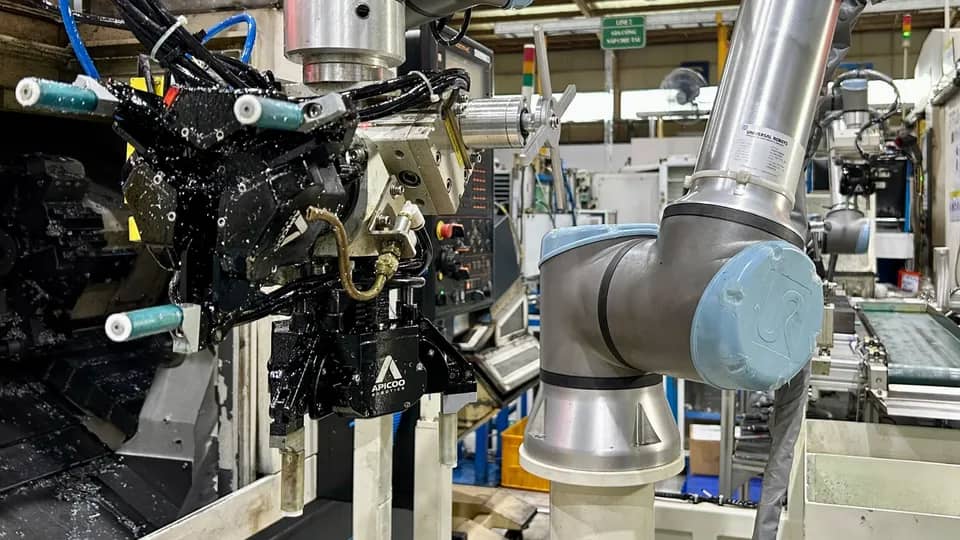
Sumitomo's CNC machining plant in northern Vietnam runs a part family of 43 part numbers that differ in size, shape and geometry, and the line can switch between up to two or three variants a day. With that much variation, automating the line had not been practical, so it was run entirely by hand, with operators loading and unloading every part.
The cell was built with two SusGrip-3F grippers per machine, one to load and one to unload, fitted with custom fingertips designed for the part family:
Before
Every part was loaded and unloaded by hand.
After
One gripper setup handles all 43 part numbers across a Ø25–157 mm range, gripping from outside or inside as each part requires, with no finger changes between variants.
Rollout: three lines in eight months, with 12 units in operation.
See how it work in production:
When a standard SusGrip-2F or 3F does not fit a part family, the same mechanism can be scaled into a larger or smaller version, or adapted into a customized gripper.
Conclusion
High-mix, low-volume manufacturing is becoming the norm because demand is splitting into more variants and smaller batches. Fixed automation struggles with that kind of production, and the skilled labor to run it by hand is getting harder to find. Cobots, software and vision now make it practical to automate across a part family, but a cell is only as flexible as its gripper. In HMLV, that means judging a gripper by how much of the family one setup can cover: reach for the range of sizes, control for the range of gripping conditions.
If you are working out whether one gripper setup can cover your part family, talk to our team or see SusGrip-3F and SusGrip-2F.