
Introduction
Small and medium-sized enterprises (SMEs) often struggle with high automation costs and complex robotic integrations. Finding a cost-effective smart gripper that balances performance, affordability, and ease of use is critical for these businesses. This is where smart grippers – electric, software-controlled grippers – offer a practical way in, without the compressed-air infrastructure or integration complexity that often comes with automation.
In this article, we’ll break down what makes a gripper “smart,” the five benefits that matter most for SMEs, and what to look for before choosing one.
What Makes a Gripper "Smart"?
A smart gripper does more than open and close its jaws. It can sense what it is holding, adjust gripping force automatically, and communicate with the robot controller.
Unlike a traditional pneumatic or electric gripper, most smart grippers include built-in sensors and software-configurable control. Users can change grip force, speed, or jaw position through software instead of mechanical adjustments.
This makes one gripper suitable for handling different part sizes and materials with minimal setup. Many smart grippers can also report data such as object detection, grip confirmation, or motor current, giving the robot feedback during operation.

For a deeper technical breakdown, see What Is a Smart Gripper?.
Top 5 Benefits of Smart Grippers for SMEs
1. Lower Total Cost of Ownership
Although a smart gripper typically costs more than a comparable pneumatic or vacuum gripper, the purchase price is only part of the investment.
Pneumatic and many vacuum grippers rely on supporting air infrastructure, including compressors, air preparation units, tubing, valves, or vacuum generators. These components add installation costs and require ongoing maintenance throughout the system’s lifetime.
A smart gripper eliminates much of this additional hardware. Once installation and maintenance costs are considered, the overall cost of ownership can be comparable to, or even lower than, traditional alternatives, depending on the application.
For SMEs investing in their first automation cell, reducing supporting equipment can make automation simpler to deploy and improve the project’s return on investment.

For a detailed comparison between electric gripper and pneumatic gripper, see Electric Vs. Pneumatic Gripper For High-Mix Machine Tending: What Actually Works?
2. Easier Integration Without a Dedicated Automation Engineer
Many smart grippers are designed to integrate quickly with modern cobots. They often support standard communication protocols such as Modbus or digital I/O and provide ready-to-use plugins for popular robot platforms like Universal Robots.
This reduces the amount of custom programming needed during setup and makes deployment easier, even for companies with limited automation experience.
For SMEs without a dedicated automation engineer, faster integration means less dependence on external system integrators and a shorter path from installation to production.
3. Handle More Product Variants with One Gripper
Many smart grippers allow jaw position, gripping force, and motion settings to be configured in software. When the gripper and fingers are suitable for the application, introducing a new product variant often requires updating these settings rather than replacing the gripper or changing tooling.
This reduces changeover effort and makes it easier to reuse the same gripper across multiple production lines or future automation projects. For SMEs, that means expanding automation without standardizing on a different gripper for every new application.
For example, Apicoo Robotics‘ SusGrip 3F was deployed in a CNC machine tending application, where a single gripper handled 43 SKUs ranging from 25 mm to 157 mm without tool changes while operating in coolant, cutting oil, metal chips, and dust. The video below shows the application in production.
4. Built-In Data and Diagnostics
Unlike traditional pneumatic or vacuum grippers, many smart grippers can provide feedback about every gripping cycle. Built-in sensors can report information such as jaw position, object detection, or motor current directly to the robot controller.
This feedback helps detect problems such as a missing part, an incomplete grip, or other abnormal gripping conditions before the robot moves to the next step. Because these sensing functions are built into the gripper, manufacturers can gain additional process visibility without installing a separate sensor package.
For SMEs, this means better visibility into the process without adding extra sensors or increasing system complexity.
What to Look for When Evaluating a Smart Gripper
Not every smart gripper fits every application. Before buying, check the following.
Payload and Grip Force
Choose a gripper based on the most challenging part it needs to handle, not just the average one. A gripper’s rated payload is only part of the picture.
Also compare the available grip force (N) with the part’s weight and surface characteristics. A heavy but smooth part may still slip, even if it falls within the gripper’s rated payload, because low surface friction reduces the holding force.

Stroke Range
Choose a stroke range that covers your full product mix, not just today’s production.
It’s easy to select a gripper that fits your current parts, only to find it doesn’t have enough stroke when a new product is introduced. If your product range is expected to grow, consider the near-term production roadmap as well as current requirements.
Integration Protocol
Check that the gripper is compatible with your existing robot controller or PLC. A gripper with a native plug-in for your cobot platform, such as a URCap for Universal Robots – typically requires less programming and is faster to deploy than one that relies only on generic communication protocols such as Modbus or digital I/O.
Environmental Rating (IP Rating)
Choose an IP rating that matches your operating environment. Applications involving coolant, dust, or moisture require more protection than a clean assembly line.
For example, IP54 may be sufficient for occasional splashes and dust, while applications with continuous coolant exposure often require a higher IP rating or a gripper specifically designed for those conditions.

Total Installed Cost
Don’t evaluate a gripper based on the purchase price alone. Also consider accessories such as cables, mounting flanges, communication modules, and any required software licenses.
These additional components can significantly affect the total cost of deployment and are often overlooked during the initial comparison.
Where SusGrip Fits
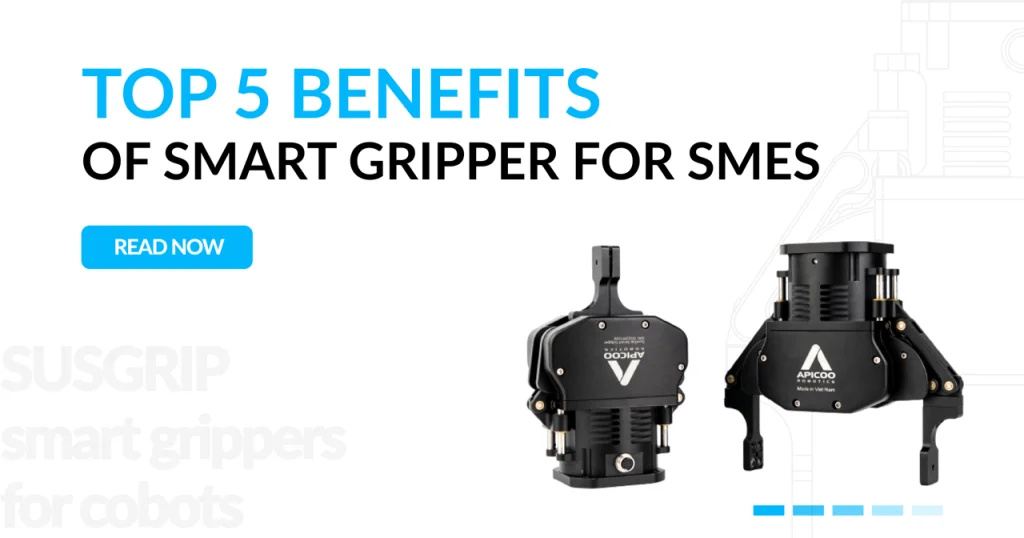
SusGrip is Apicoo Robotics’ smart electric gripper line, available as the two-finger SusGrip 2F (128mm stroke, 5kg payload) and three-finger SusGrip 3F (10–150mm range, 5kg payload). It puts the benefits above into practice:
- Easy integration: Modbus/GPIO control with plug-and-play support for Universal Robots (URCap), Agile Robots, TM Robot, and FANUC.
- Flexibility: 128-150mm stroke across the 2F/3F range, enough to cover a wide span of part sizes with one tool.
- Built-in intelligence: object detection and an absolute encoder for real-time position feedback.
- GUI: an intuitive graphical interface for configuration, operation, and monitoring – minimal training required.
Conclusion
For SMEs looking for an affordable, easy-to-use, and versatile collaborative robot gripper, SusGrip is the perfect solution. With its cost savings, long-stroke versatility, plug-and-play ease, minimal training requirements, and scalable automation, it’s the ideal choice for small businesses embracing automation.
Ready to see SusGrip in action? Contact us today for a demo!