
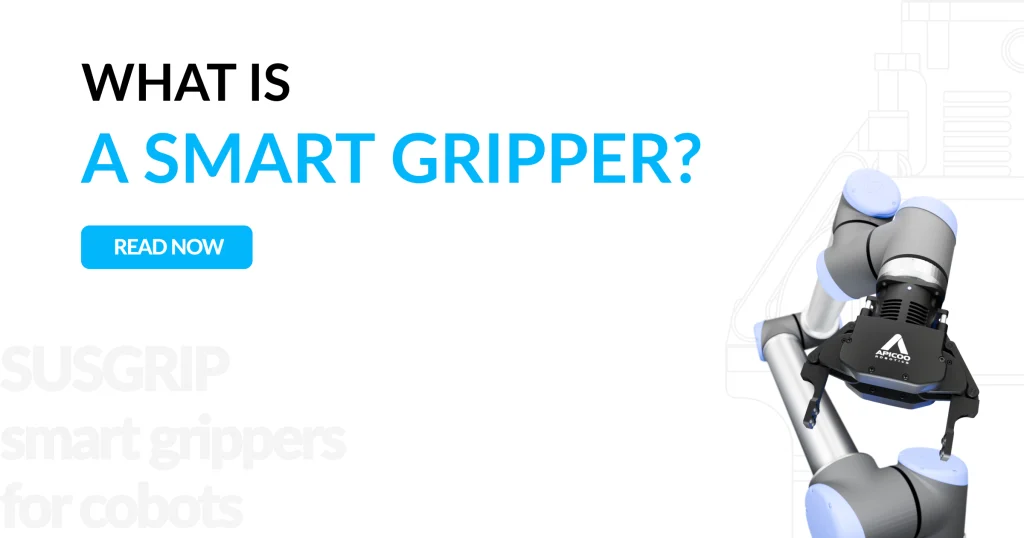
Have you ever wondered what a smart gripper is and how it can transform automation for high-mix, low-volume (HMLV) manufacturing? If you’re constantly switching between different parts, or just want to automate without adding complexity, you’re in the right place.
This article defines what actually makes a gripper smart, why that capability matters specifically in HMLV production, where its limits are, and how to choose one.
What Is a Smart Gripper?
A smart gripper is a robotic end-effector that grabs, holds, and manipulates objects with advanced control, unlike traditional grippers that only open and close. These electric grippers integrate sensors, force control, and programmable settings, allowing them to handle different object sizes and materials – without needing frequent tool changes.
Smart grippers can add different kinds of sensing – force/torque feedback, proximity sensing, or even integrated vision – and capabilities vary accordingly.

How Does a Smart Gripper Work?
Traditional electric grippers execute simple open-and-close commands. Once a gripping force is set, they repeat the same motion for every workpiece without knowing whether the part has been picked successfully.
Smart grippers add sensors and software on top of the same electric gripping mechanism. Depending on the design, they can measure gripping force, track jaw position, detect failed picks, and communicate this information back to the robot controller. Instead of simply executing a motion, they continuously monitor the gripping process and adjust their behavior when needed.
How Smart Grippers Differ from Traditional Grippers
Feature | Traditional Electric Gripper | Smart Gripper |
Force control | Fixed | Adjustable |
Position feedback | Basic | Real-time |
Grip verification | No | Yes |
Profile switching | Manual | Software |
Best for | High-volume production | HMLV production |
Why Smart Grippers Fit HMLV Production
HMLV (High-Mix, Low-Volume) production is difficult to automate because products change frequently. Different part sizes, shapes, weights, and materials require different handling strategies, making it challenging for traditional robotic grippers to keep up.
Smart grippers are designed to adapt to these changing conditions. By automatically adjusting gripping parameters, storing multiple gripping profiles, and providing real-time feedback, they allow a single robotic cell to handle a much wider variety of products with less manual intervention.
Faster Changeovers
Frequent product changeovers are part of everyday operation in HMLV manufacturing. With traditional grippers, switching to a new product often requires manual adjustments, such as changing gripper fingers or reconfiguring gripping force.
A smart gripper stores multiple gripping profiles in software. When production changes to a different product, the operator simply loads the appropriate profile, automatically applying the correct stroke, force, and speed settings. This reduces setup time and minimizes manual intervention, allowing manufacturers to switch between products more efficiently.
For example, in a CNC machine tending application, the Apicoo SusGrip-3F handled 43 different SKUs ranging from 25 mm to 157 mm using a single gripper. The previous setup required eight separate pneumatic grippers to cover the same product range.
Real-Time Force Adjustment
Traditional grippers apply a fixed gripping force. If the force is set too high, fragile parts may be damaged. If it is too low, heavier parts can slip during handling.
A smart gripper solves this problem by monitoring gripping force while the jaws are closing. It automatically adjusts the force until the required value is reached, instead of relying on one fixed setting.
This is especially useful in high-mix production, where different products may require different gripping forces. A single smart gripper can safely handle both delicate plastic components and rigid metal parts with little or no manual adjustment between jobs.
Grip Verification
A robot cannot tell whether a part has been picked successfully unless the gripper provides feedback. If a part slips or is missed entirely, the robot may continue its programmed motion, leading to dropped parts, machine jams, or failed assembly steps.
A smart gripper solves this problem by verifying every pick. Using its built-in force sensor, it can detect whether the expected gripping force has been reached and confirm that a part is actually held before the robot moves away.
This feature is especially valuable in high-mix production, where frequent product changeovers increase the chances of picking errors. Instead of discovering a failed pick later in the process, the robot can stop immediately or retry the operation, reducing downtime and preventing defects.

Vision-Based Recognition
For smart grippers that integrate a vision system, the gripper can capture an image of the part, match it against stored profiles, and load the corresponding settings without operator input.
This capability only pays off where part variety exists in the first place. HMLV cells running several part variants through the same station benefit most: without vision, an operator has to select the right profile manually at every changeover, and the risk of loading the wrong one compounds with each additional variant in the mix.
Trade-Offs of Smart Grippers
A smart gripper isn’t a universal upgrade. Several trade-offs are worth weighing before choosing one.
Higher upfront cost
Smart grippers cost more than basic electric or pneumatic grippers because they include sensors, software, and communication capabilities. The additional investment is worthwhile only if those features are used in daily production.
For production lines that run the same part continuously, a basic gripper often delivers the same result at a lower cost. In these cases, the flexibility of a smart gripper may provide little return on investment.
Lower Maximum Gripping Force
Electric smart grippers generally produce less gripping force than pneumatic grippers of a similar size. While this is sufficient for many assembly and machine tending applications, it may not be enough for large or heavy workpieces.
Before selecting a smart gripper, manufacturers should calculate the required gripping force, including an appropriate safety factor, rather than relying on the maximum force listed in the specification.
Learn more in our detailed comparison of electric vs. pneumatic grippers for HMLV production.
Environmental Protection
Sensors, motors, and electronic components are more sensitive to harsh environments than simple pneumatic actuators. Applications involving coolant, metal chips, water spray, or abrasive dust require careful attention to the gripper’s environmental protection rating.
Choosing a gripper with an appropriate IP rating helps ensure reliable operation and reduces the risk of premature failure.

Integration and Setup
A smart gripper offers greater flexibility, but it also requires more initial configuration. Force thresholds, gripping profiles, and communication settings must be tuned before production begins.
For highly diverse applications, a single smart gripper may still not cover every part. Extremely different geometries or materials may require additional vision guidance, custom gripper fingers, or even multiple end-effectors.
How to Choose a Smart Gripper
Choosing the right smart gripper is not about selecting the model with the most features. The best choice depends on your application, the parts being handled, and the level of flexibility your production line requires.
Before comparing specifications, identify the problem you want the gripper to solve. Then evaluate whether its sensing, mechanical capabilities, and integration options match your production needs.
Check Robot Compatibility First
A smart gripper is only valuable if it integrates smoothly with your robot or cobot. Before comparing performance specifications, verify that the gripper supports your robot brand and control system.
Look for certified compatibility with platforms such as Universal Robots, FANUC, TM Robot, JAKA, or other robots used in your facility. Also check the available communication protocol. GPIO is suitable for simple open-and-close control, while protocols such as Modbus RTU or IO-Link provide access to advanced functions, including force control, profile switching, and status feedback.
Choosing a gripper with native support helps reduce integration time and allows you to take advantage of its smart features from day one.

Match the Gripper to Your Full Part Range
The gripper should be selected based on the entire range of parts it will handle, not just the average workpiece. Review the smallest and largest part dimensions, as well as differences in weight and material. These factors determine the stroke and gripping force required for reliable operation.
If the stroke or force range is too limited, operators may still need to swap tooling or change grippers between jobs-reducing one of the main benefits of using a smart gripper in the first place.
Choose the Right Sensing for Your Application
Different applications require different levels of sensing. Selecting unnecessary sensors increases cost without improving production performance.
For most pick-and-place applications, force and position feedback are enough to prevent crushed parts and detect failed picks. Proximity sensing can improve part detection before contact, while vision systems are useful when the robot must automatically identify different products before selecting the appropriate gripping profile.
Consider the Operating Environment
The operating environment is just as important as the gripper’s technical specifications. Applications involving coolant, metal chips, washdown processes, food production, or cleanrooms may require specific materials or a higher IP protection rating. A gripper that performs well in a clean factory may not be suitable for harsh industrial environments.
What’s It Like in Action?
Why SusGrip Is Built for HMLV Manufacturing
SusGrip is Apicoo’s smart electric gripper designed specifically for high-mix, low-volume manufacturing. It combines force sensing, position feedback, and software-based configuration to help manufacturers reduce manual changeovers while handling a wider range of parts with a single gripper.
Apicoo currently offers two models:
- SusGrip 2F: Parallel gripper with a 128 mm stroke, 5 kg payload, and up to 100 N gripping force.
- SusGrip 3F: Three-finger concentric gripper with a 10-150 mm gripping range, 5 kg payload, and up to 100 N gripping force.
Key advantages include:
- One gripper for multiple product: The wide stroke range allows a single gripper to handle many different part sizes, reducing the need for dedicated tooling.
- Faster product changeovers: Stroke, gripping force, and speed are configured through software, allowing the robot to switch products by loading a new profile instead of changing hardware.
- Instant startup with an absolute encoder: The gripper knows its jaw position immediately after power-up, eliminating the need for a homing sequence before production begins.
- Flexible control options: Supports GPIO for simple pick-and-place applications as well as Modbus RTU for advanced control and parameter adjustment. For more details, read this article: Multi-Control Modes in Apicoo SusGrip Smart Grippers
- Easy robot integration: Compatible with Universal Robots (URCap), Agile Robots, TM Robot, and FANUC, helping reduce commissioning time.
- Lower tooling costs: A single gripper can often replace multiple dedicated grippers in HMLV applications, simplifying maintenance and reducing end-of-arm tooling costs.
Conclusion
Smart grippers are not a replacement for every traditional gripper. In stable, high-volume production, a basic electric or pneumatic gripper may be the more practical and cost-effective choice.
However, HMLV manufacturing presents a different challenge. Frequent product changeovers, varying part sizes, and the need for reliable pick verification require a gripper that can adapt without constant manual intervention. In these environments, features such as programmable gripping profiles, force sensing, and position feedback can significantly improve flexibility and reduce downtime.
If you’re exploring automation for an HMLV production line, SusGrip was designed with these challenges in mind. You can request a free trial or contact the Apicoo team to discuss your application and determine whether it’s the right solution for your production needs.