


From 12 Finger Swaps to Zero: SusGrip-3F for High-Mix Low-Volume Machine Tending


On This Page
- Problem Overview
- Apicoo's Solution
- How SusGrip Solved the Problem
- A misplaced finger risked a failed grip
- Each swap needed an expert and stopped the line
- Heavy, oil-coated shells needed higher force and more friction
- High cycle count required a repeatable grip position
- Every grip had to be confirmed
- Before / After
- Deep-Dive: Why High-Mix Production Is Driving a Shift from Pneumatic to Electric Gripper
- What changes when a line goes high-mix
- Why electric can now take over
- Where pneumatic still fits
- Talk to Apicoo About This Application
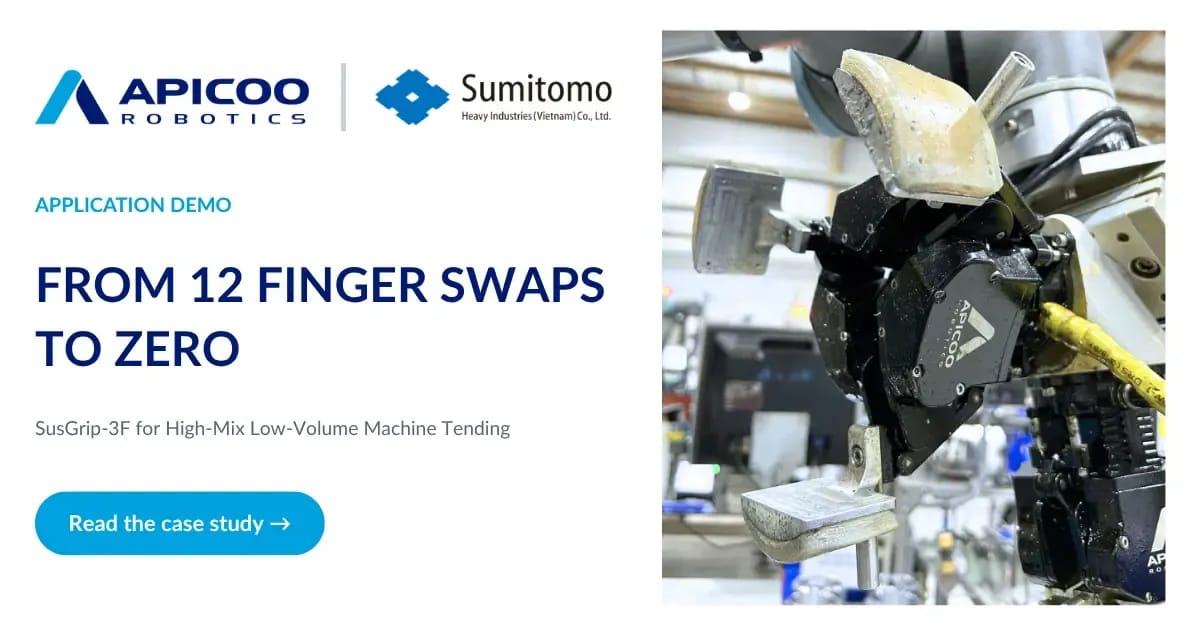
Problem Overview
Sumitomo Heavy Industries (Vietnam) Co., Ltd. runs a machine-tending line for large shell components, with two cobot arms carrying two three-finger pneumatic grippers each.
The line handles only three shell sizes, but each runs in small batches, so sizes change often. Every size change meant replacing all 12 fingers, each numbered to a set position on its gripper.
Each changeover stopped the line for the finger swap and a grip check, and could only be done by an experienced technician. A single misplaced finger risked a failed or inconsistent grip. With small batches, this cost was incurred at every changeover.
12 fingers swapped per changeover | ~2kg slippery surface | Expert required every time |
Apicoo's Solution
Apicoo replaced the four pneumatic grippers with four SusGrip-3F units. Each unit is fitted with custom fingers for internal gripping, and each gripper covers all three shell sizes without changing fingers.
A size change is now made in software: stroke, gripping force and speed for each size are saved as a stored setting, and the operator selects it
90-230mm stroke | 160N gripping force | 5kg payload |
How SusGrip Solved the Problem
Pneumatic grippers have real strengths: at common sizes they often deliver more force for their size, they cost less per unit, and the factory already had compressed air, so no additional infrastructure was needed.
The deciding factor for switching was changeover cost, driven by two things: time and people. Every size change stopped the line for a finger swap, and only an expert could do it. On an automated line, any step that still needs a person is costly: the line waits for them, and their skill has to be paid for.
A misplaced finger risked a failed grip
Problem
On this line, the pneumatic grippers could not cover all 3 shell diameters with one set of fingers. Each size had its own finger set, so every part change meant replacing all 12 fingers across the 4 grippers.
Each finger is numbered to its position, and one fitted wrongly risks a failed or inconsistent grip.
How SusGrip Solve It
One SusGrip-3F with one set of custom fingers covers all three sizes, so there is no finger swap.
Each size is set by a stored parameter set instead of fitting fingers by hand, which reduces the risk of a failed or inconsistent grip.
Each swap needed an expert and stopped the line
Problem
Swapping and repositioning 12 fingers correctly requires an expert, plus check time afterward to verify placement before the line can restart. All of it counted as downtime.
How SusGrip Solve It
With no fingers to change and the size set in software, no expert is needed and downtime is shorter.
Heavy, oil-coated shells needed higher force and more friction
Problem
Each shell weighs about 2 kg, is large, and is coated in oil, which makes it hard to hold securely from the inside.
How SusGrip Solve It
Gripping force was custom-rated to 160 N for this application, above the gripper’s standard rating.
Custom fingertips with a larger contact surface and a higher-friction material hold on the oily surface.

SusGrip-3F's custom fingertips - sized for a larger contact surface and secure inside grip - shown coated in coolant oil after continuous operation on the line.
High cycle count required a repeatable grip position
Problem
The line runs 3 shifts a day, handling about 180 parts per shift with 10 grip cycles per part, around 1,800 grip cycles per shift. Across that many cycles, the grip position has to stay consistent from the first cycle of a shift to the last.
How SusGrip Solve It
SusGrip 3F has a rated repetition accuracy of 0.1 mm, and its actuation is designed for low backlash, so the grip position stays consistent from cycle to cycle.
Every grip had to be confirmed
Problem
At around 1,800 grip cycles per shift, a dropped or badly held part has to be detected immediately, before it reaches the machine.
Pneumatic grippers typically need add-on sensors for this, and standard position switches report only open or closed, not part size.
How SusGrip Solve It
Object detection is built into the gripper. An absolute encoder tracks the position of each finger at all times.
The gripper records the position when it closes on a part and flags a dropped part if that position changes.
The same data confirms the part size, with no external sensors.
Before / After
Before | With SusGrip-3F | |
Tooling | 4 pneumatic grippers, 12 fingers (3 per gripper) replaced at every size change | 4 SusGrip 3F units with custom internal-grip fingers, no finger swap between sizes |
Changeover | An expert replaces all 12 fingers by hand | An operator changes size in software |
Downtime | Line stopped for the finger swap and the check it required | Shorter pause: the size is selected in software, with no finger swap or check |
Grip reliability | A finger fitted slightly wrong risks a failed or inconsistent grip | Fingers are no longer fitted at each changeover, reducing that risk |
Grip confirmation | External sensors needed to confirm grip, size or a dropped part | Grip, size and dropped parts detected by the gripper itself |
Deep-Dive: Why High-Mix Production Is Driving a Shift from Pneumatic to Electric Gripper
What changes when a line goes high-mix
In stable production, a gripper is set up once and repeats the same cycle for weeks. When batches shrink and sizes change often, the cost that decides the choice of gripper moves from the gripper itself to the changeover. This line has only three SKUs, but small batches made it high-mix in practice

Changeover steps for a size change: pneumatic gripper vs. electric gripper (SusGrip-3F).
A pneumatic changeover has up to four steps: swap the fingers, adjust the pressure, test the grip, and restart. Pressure only needs adjusting when parts vary greatly. On the Sumitomo line, the shells are all large and similar enough in size and weight to share one pressure setting, so that step was skipped. The finger swap and grip test remained manual, and the swap needed an expert.
With an electric gripper like SusGrip-3F, stroke and force are stored settings and the gripper confirms its own grip, so the same change takes two steps: select the setting and restart.
Fewer steps means a shorter line stop and no step that depends on an expert, and that saving repeats at every size change. How much this saving is worth depends on three questions:
- Does a size change require new fingers? If all sizes fit within one stroke, the same fingers handle them all and there is little to save. If they do not, every size change means swapping fingers.
- How often do sizes change? A finger swap means a stopped line. A line that changes size once a month pays that cost once a month. A line running small batches pays it with every batch.
- How costly is each changeover? A longer swap keeps the line stopped longer, which means more lost output. If the swap needs a skilled technician, it also adds the cost of employing one, and the line may have to wait until they are available.
On the Sumitomo line, all three pointed the same way: three diameters that no single finger set could cover, small batches, and 12 numbered fingers that needed an expert.
Why electric can now take over
Electric grippers offer more than a faster changeover. Position, force and speed are programmable and stored per part. Built-in position feedback confirms the part, checks its size and detects a drop, where pneumatic grippers typically need add-on sensors or servo valves. Grip force stays consistent regardless of air pressure, hose length or temperature, and no compressed air is needed.
These advantages only matter if the electric gripper first does everything the pneumatic one was already doing well. A gripper that changes size in software but cannot hold the part securely is no improvement.
On this line, the pneumatic grippers were already:
- Holding heavy, oily parts securely: Each shell weighs about 2 kg and is coated in coolant oil, gripped from the inside.
- Reaching the largest sizes. The shells run up to 230 mm.
- Running reliably in the cell. The line runs 3 shifts a day in coolant oil.
- Keeping the grip position consistent. At about 1,800 grip cycles per shift, the grip has to repeat from the first cycle to the last.
That is what drives the shift: not that electric grippers became more flexible, but that they can now match pneumatic in demanding applications such as CNC machine tending.
Where pneumatic still fits
Pneumatic grippers keep real strengths: a lower purchase price, high force for their size, robustness, fast cycles and simple maintenance. Where parts do not change often, those strengths still decide. Pneumatic remains the practical choice, for example, on:
- Lines that run one part for long periods, or several sizes that fit within one stroke, so fingers rarely need changing.
- High-speed pick-and-place, where the shortest cycle time matters most.
- Compact cells that need high grip force from a small, light gripper.
- Simple gripping tasks that need no grip data or fine force control, in plants with compressed air already in place.
The shift therefore happens application by application, not across a whole plant at once. Our comparison of electric and pneumatic grippers for high-mix CNC machine tending covers these trade-offs in full.
Proven at Scale
Since deploying SusGrip-3F on this line, Sumitomo Heavy Industries (Vietnam) Co., Ltd has placed 3 repeat orders - 12 additional units across 3 more production lines, each addressing a different machine-tending application
Talk to Apicoo About This Application
If your facility has a CNC machine tending application - high-mix, multi-SKU, or harsh environment - contact us. We'll walk through the application with you.