Grippers vs. Dexterous Hands for Industrial Humanoid Robots: How to Choose


On This Page
- 1. What's the Difference? Grippers vs. Dexterous Hands
- a. Robotic Grippers
- b. Dexterous Robotic Hands
- c. Grippers vs. Dexterous Hands: A Side-by-Side Comparison
- 2. When Does a Gripper Win?
- a. Stable, Repeatable Tasks
- b. High-Speed Production
- c. Harsh Industrial Environments
- d. Limited Budget or Integration Resources
- e. Weight and Power Budget on a Humanoid
- 3. When Does Dexterity Win?
- a. Objects That Are Genuinely Unpredictable
- b. Tasks Requiring In-Hand Manipulation
- c. Using Tools Made for People
- d. Who Owns the System?
- 4. A 6-Step Framework for Choosing the Right End Effector For Humanoid
- Step 1: Define the Task
- Step 2: Do You Need In-Hand Manipulation?
- Step 3: How Much Can You Predict in Advance?
- Step 4: Can a Gripper Meet the Performance Requirements?
- Step 5: Can Your System Support the Required End Effector?
- Step 6: Is the Added Capability Worth the Cost at Scale?
- 5. How SusGrip 2F Is Designed for Humanoid Robots
- Conclusion
Key Takeaway
- Grippers grip and release reliably with fewer moving parts - but can't reposition an object in-hand.
- Dexterous hands can manipulate objects in-hand and sense contact through tactile feedback - at the cost of higher price, complexity, and lower reliability today.
- The right choice depends on your task, not which technology looks more advanced: how much in-hand manipulation you actually need, how predictable your objects are, and whether your control system and budget can support the added complexity.
In the first half of 2026, two humanoid makers ran robots in real production environments. They used very different end effectors.
Figure’s F.03 robots sorted packages for 200 continuous hours, handling 249,560 parcels with their own dexterous hands. AgiBot took a different approach. At a Longcheer tablet factory, its G2 robots completed 64,828 handling operations with less than 4% downtime, using a gripper, despite building and selling its own dexterous hands, including the OmniHand series.
These two deployments raise a practical question: if a humanoid robot can use either a dexterous hand or a conventional gripper, what determines which one makes sense for a given application?
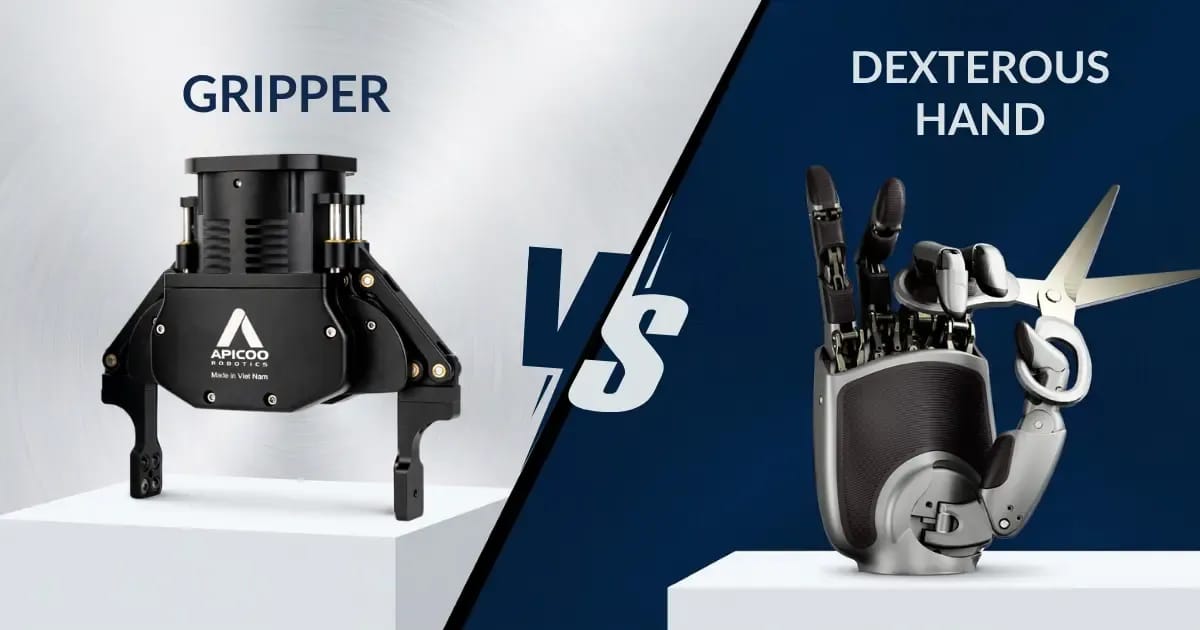
This article defines industrial grippers and dexterous hands, examines the key differences between them, and provides a practical framework for choosing between the two.
1. What's the Difference? Grippers vs. Dexterous Hands
a. Robotic Grippers
A robotic gripper is an end effector that grasps and holds an object securely while the robot's arm moves it into position. Unlike a dexterous hand, it doesn't attempt to replicate the full range of human finger movements.

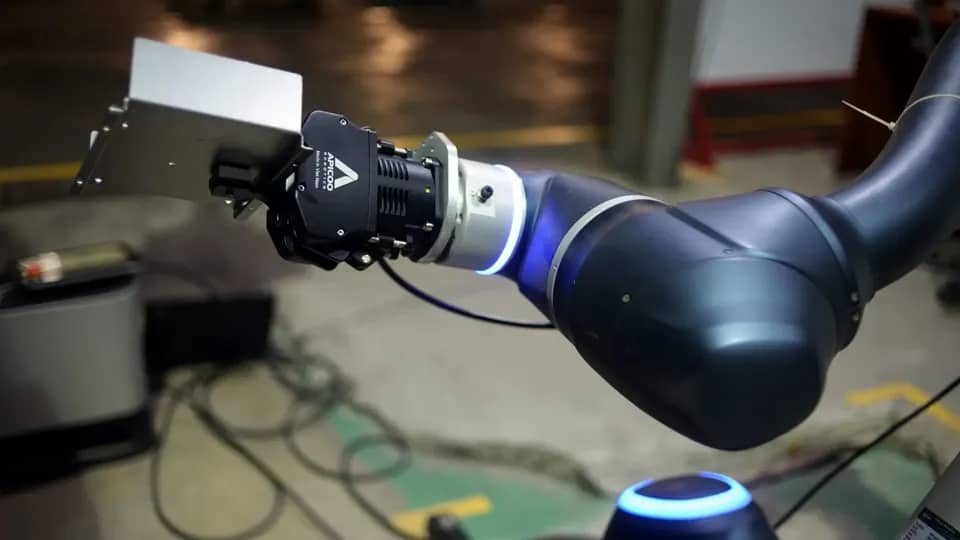
Apicoo Robotics’ SusGrip 2F integrated with a humanoid robot.
Depending on the application, several gripper designs are commonly used:
- Mechanical grippers: Use two or more physical fingers or jaws- powered by electric motors, pneumatics, or hydraulics - to clamp an object. They are widely used in pick-and-place, machine tending, and assembly.
- Vacuum grippers: Use suction cups and pressure differences to lift flat or relatively smooth surfaces such as glass, sheets, and packaging materials, making them common in packaging, logistics, and electronics.
- Soft grippers: Use flexible materials such as silicone to safely grasp delicate or irregularly shaped objects such as food, produce, or fragile consumer products.
- Magnetic grippers: Use permanent magnets or electromagnets to pick up ferromagnetic parts such as steel sheets and machined components, without relying on mechanical fingers.
Grippers typically cannot reorient an object in-hand in the same way a dexterous hand can. Their fingers generally lack the independent motions needed to reposition an object while maintaining a grasp.
That does not mean the object is limited to a single orientation, though. A robot can still reorient a part by loosening its grip and allowing gravity to pivot it, or by pressing it against a fixture to align it, established techniques in industrial automation. In these cases, the capability is not absent; it simply moves from the hand to the robot and surrounding cell.
That simpler architecture can also reduce hardware and integration complexity, while making it easier to achieve the reliability required for repetitive production. This makes grippers well suited to many repetitive, well-defined industrial tasks.
b. Dexterous Robotic Hands
A dexterous robotic hand is a multi-fingered end effector with independently actuated joints, designed to grasp and manipulate objects. Unlike a conventional gripper, it can reposition or reorient an object within the hand without releasing it or moving the arm. This capability, known as in-hand manipulation, is one of the key differences between dexterous hands and grippers.

Source: Ozrobotics
Many dexterous hands also integrate tactile or force sensors in their fingertips, providing real-time feedback on contact, pressure, and slip. This allows the hand to adjust its grip dynamically, which is particularly important for delicate objects and in-hand manipulation.
Depending on their design, dexterous hands generally fall into two broad categories:
- Basic multi-finger hands: Three or four fingers with moderate degrees of freedom, providing more grasping flexibility than a conventional gripper without fully replicating human dexterity.
- Anthropomorphic hands: Five-finger designs modeled more closely on the human hand, enabling a wider range of human-like grasps and in-hand manipulation.
The added dexterity comes with a trade-off. More fingers, joints, actuators, and sensors increase both mechanical and control complexity, making dexterous hands more expensive and generally less robust than industrial grippers. Packing that many actuators into finger-sized volumes also caps how hard each fingertip can push. Some of the most capable tactile hands on the market deliver around 20 N at the fingertip, well under the 100-400 N a comparable industrial gripper can clamp with.
As George Chowdhury, Senior Robotics Analyst at ABI Research, noted, "having 27 degrees of freedom adds so much that can go wrong." More capability often means more components to integrate, calibrate, and maintain.
c. Grippers vs. Dexterous Hands: A Side-by-Side Comparison
Criterion | Grippers | Dexterous Hands |
Degrees of freedom | 1-3 | 9-24+ |
Grip force | 100-400 N | ~20 N at the fingertip |
Object diversity handled | High for known, bounded sets | Better suited when objects are unknown or unpredictable at grasp time |
In-hand manipulation | Not supported | Supported (reorientation, tool use) |
Tactile/force feedback | None, or basic force/torque sensing at the wrist on some models | Often integrated per fingertip, enabling closed-loop grip control |
Cycle time | Fast, minimal variability | Slower, more variable |
Rated cycle life | Millions of cycles, commonly published | Rarely published - still an early product category |
Integration complexity | Low - mature drivers, established tooling | Higher - often requires custom control, tuning, or learned policies |
Cost (CAPEX) | Roughly $200-$15,000 for most industrial models | Roughly $1,500-$300,000+ depending on sophistication |
Deployment maturity | Established in industrial automation | Mostly pilots and early commercial rollouts as of 2026 |
2. When Does a Gripper Win?
a. Stable, Repeatable Tasks
Grippers are the better choice when the robot handles a defined set of parts with predictable shapes and positions. If the task is to repeatedly pick metal blanks, cartons, machined components, or other standardized objects, a dedicated gripper can perform the job with far less complexity than a dexterous hand.
b. High-Speed Production
Tasks measured in cycles per minute rather than seconds per grasp generally favor a gripper's simpler, faster actuation. If the task does not require in-hand manipulation, the additional actuation and control complexity may not provide a practical benefit.
AgiBot's Longcheer line provides a real example: 64,828 handling operations in 64 hours, with downtime held under 4%, using parallel grippers.
c. Harsh Industrial Environments
Factories expose robots to coolant, dust, vibration, and temperature changes. Industrial grippers are commonly designed for these conditions, whereas dexterous hands-with more joints, actuators, and sensors - are generally harder to protect and maintain over long production runs.

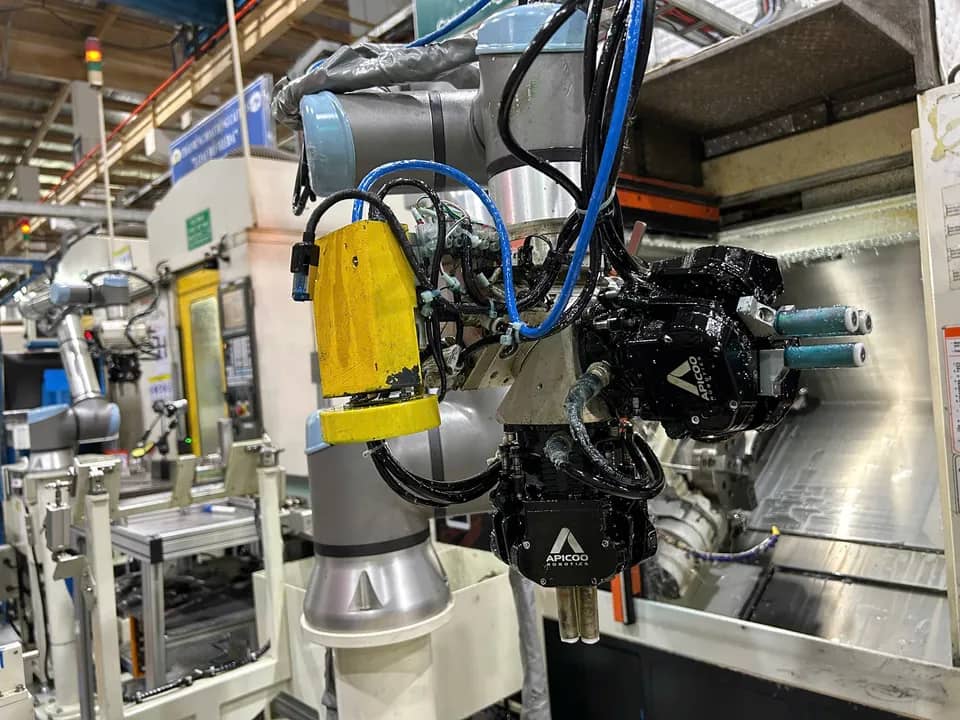
Apicoo’s SusGrip performs reliably in harsh CNC machine tending environments with coolant, oil, and dust.
d. Limited Budget or Integration Resources
A gripper can usually be integrated with existing ROS or PLC tooling in days, without a dedicated machine-learning engineer. AgiBot's Longcheer line was integrated in 36 hours - a sign of how mature gripper integration tooling already is.
e. Weight and Power Budget on a Humanoid
On a fixed industrial arm, the mass of the end effector is often less restrictive because the robot is powered from the grid and typically has a larger torque and payload margin. On a humanoid's wrist, the trade-off is more significant: every gram adds inertia, affects response, and draws from a battery the whole robot depends on.
A gripper can make better use of that limited mass budget for tasks that primarily require holding force. A collaborative electric gripper and a dexterous hand can fall into a similar mass class, roughly 1 kg versus 1.2 kg, but a gripper can provide 100-400 N of clamping force, compared with roughly 20 N at a dexterous hand's fingertip. For a humanoid operating within a fixed torque and power budget, that translates into more holding capability per gram carried.
3. When Does Dexterity Win?
a. Objects That Are Genuinely Unpredictable
“Our parts vary” is not, by itself, a reason to reach for a dexterous hand, it is often a fingertip problem. Adaptive or interchangeable fingers can give a gripper a wider range of shapes without adding motors or control complexity. If a warehouse has numerous SKUs but each one has a known, bounded geometry, a gripper with the right fingertips can often cover them.
The threshold for a dexterous hand is when the object is genuinely unknown at the moment of grasp: unpredictable weight distribution, unstructured materials, or an orientation that cannot be resolved in advance. Parcels, bagged goods, textiles, and produce are clearer examples. In these cases, a dexterous hand's per-fingertip sensing allows it to feel and adjust its grip in real time, rather than relying on a grasp that has to be correct on the first attempt.
b. Tasks Requiring In-Hand Manipulation
Reorienting a part without releasing it is a task a gripper cannot perform on its own in the same way a dexterous hand can. Its fingers generally lack the independent motions needed to reposition the object while maintaining the grasp.
This becomes important when the task requires continuous adjustment of the object in the hand, for example, turning a doorknob, pressing a button, or manipulating an object designed for human hands.

Humanoid robot performing household chores (NVIDIA Developer)
c. Using Tools Made for People
If both arms of a bimanual robot are holding the workpiece, one holding, one turning, grippers are sufficient. Robots have coordinated two gripper-equipped arms this way for decades. The difference appears when one arm needs to hold a tool designed for human use, such as a screwdriver, drill, or caulking gun. A gripper can clamp the tool, but it cannot pull a trigger shaped for a finger.
Even then, the first question should be whether the robot needs to hold a human tool at all. In industrial automation, the usual solution is to mount the tool directly to the arm, a driver, spindle, or nutrunner, which is faster and more reliable than reproducing the human method. The case for a dexterous hand becomes stronger when a dedicated tool head is not practical, such as a task performed only a few times a year where the engineering effort is difficult to justify and the human tool is already available.
d. Who Owns the System?
A dexterous hand's capability is not fully contained in the hardware. Using one effectively can also require simulation, demonstration data, control policies, and people who can retrain and maintain the system. This changes who a dexterous hand makes sense for.
If you already build manipulation software, a robot-learning team or a humanoid platform vendor, a dexterous hand can be integrated into an existing software stack. If you are buying a complete robot with the software included, similar to how AgiBot supplies hands, models, and deployment support as one system to its customers, the question becomes one of vendor dependency rather than hardware capability.
For manufacturers and system integrators fitting a hand to their own robot, the hardware may be only one part of the integration challenge. The larger effort can sit in the software, training, deployment, and ongoing maintenance required to make the hand perform reliably.
4. A 6-Step Framework for Choosing the Right End Effector For Humanoid
Step 1: Define the Task
Before applying any of the criteria below, write down exactly what the robot needs to do, not just what it needs to hold, but every step between picking the object up and setting it down. A simple pick-place-repeat sequence and a task that requires reorienting a part mid-cycle look similar on paper but lead to very different answers below.
Step 2: Do You Need In-Hand Manipulation?
If the robot only needs to pick, hold, and place objects, a gripper is usually the right choice, and that covers many reorientation tasks too, since a fixture, a regrasp station, or the arm's own motion can often reposition a part without doing it in-hand.
The real trigger is narrower: is there a moment where the part must turn while the gripper is holding it, with nowhere to set it down and no fixture to press it against? If yes, continue to the next step.
Step 3: How Much Can You Predict in Advance?
If your objects are a known, bounded set- even if there are many of them- a gripper, often paired with vision-guided grasping, can usually be configured to handle them.
If objects are unpredictable enough that the robot needs to feel and adjust its grip in real time, unknown weight, fragile materials, unstable orientation, that points toward a dexterous hand's sensing capability, not just its finger count.
Step 4: Can a Gripper Meet the Performance Requirements?
Even when Steps 2 and 3 point toward a gripper, check the raw numbers against your job: required grip force and payload, cycle time, positioning precision, and environmental exposure to dust, oil, vibration, or temperature. A gripper that can't hold the part securely or survive the environment isn't a fit, regardless of how well it scores on the questions above.
Step 5: Can Your System Support the Required End Effector?
Industrial grippers integrate easily with established PLC and ROS workflows. Dexterous hands often require more advanced control, perception, or AI-based manipulation, and if you're fitting one to your own robot and integrating it yourself, that's a development programme, not just a hardware swap.
Many dexterous hands rely on manipulation policies trained for specific objects, so when a new part variant arrives, someone has to retrain or reconfigure that policy. Name that person; if there isn't one, you're not ready to operate it.
Step 6: Is the Added Capability Worth the Cost at Scale?
Look past the hardware price to integration, maintenance, software development, and engineering time, and beyond a single robot to an entire fleet. Evaluate long-term reliability, spare-part availability, and vendor support before committing. For many industrial applications today, these factors still favor grippers over dexterous hands.
5. How SusGrip 2F Is Designed for Humanoid Robots
Industrial humanoids place particular demands on an end effector. Every gram at the wrist consumes payload and arm torque before the workpiece does, and it does so at the end of the longest lever on the robot. Battery capacity is fixed. Arm torque is fixed. And unlike a fenced cell, there’s no compressed air on board - which rules out pneumatics and vacuum before the specification starts.
For scale: a single dexterous hand runs around 1,200 g. A bimanual humanoid carries 2.4 kg of end effector before it picks anything up.
These considerations shaped Apicoo’s SusGrip 2F. At 990 g it combines a 128 mm stroke with a compact body, covering a wide range of object sizes while keeping mass and moment at the wrist low. An integrated absolute encoder reports jaw position immediately at power-up, so the gripper recovers from an interruption without a homing cycle.

Apicoo’s SusGrip 2F integrated with a humanoid robot.
Humanoid requirement | How SusGrip 2F addresses it |
Minimise wrist load | 990 g reduces load and moment at the flange, preserving effective payload |
Handle more parts with one tool | Compact body, 128 mm stroke covers a wide size range while keeping the grip point close to the wrist |
Reliable, repeatable grasping | Parallel jaw motion holds constant gripping geometry across part sizes, simplifying programming |
Reduce shear hazards | No crossing or scissoring motion between fingers — one fewer hazard in the cell risk assessment |
Recover quickly after interruptions | Absolute encoder gives jaw position at power-up, eliminating homing |
Mount to standard interfaces | 4× M5 bolts, 76–80 mm PCD adapter flange |
Grip force | 140 N (field-upgradeable to 160 N via firmware) |
Supply voltage and bus | 24 VDC; Modbus RTU / GPIO |
Environmental protection | IP67 available as an option |
Rather than chasing the highest number of degrees of freedom, SusGrip 2F is designed around what industrial humanoids need most: light construction, efficient use of payload, flexible part handling, predictable motion, and reliable deployment. For most real factory work, those characteristics matter more than human-like dexterity.
Conclusion
The rapid progress of dexterous hands doesn't mean industrial grippers are becoming obsolete. If anything, today's humanoid market shows the opposite: while companies continue pushing the boundaries of human-like manipulation, many real-world deployments still rely on simpler grippers because they deliver the reliability, speed, and cost efficiency factories demand.
The choice isn't about which technology is more advanced, it's about which one best fits the task. If your application needs fast, repeatable handling across a defined range of objects, a gripper will often be the more practical solution. If it requires in-hand manipulation, highly variable objects, or human-like tool use, a dexterous hand can provide capabilities a conventional gripper cannot.
For humanoid robots, the end effector also needs to balance capability with weight and size. SusGrip 2F is designed around these constraints, combining a 990 g weight, 128 mm stroke, parallel motion, and absolute position feedback in a compact form factor.
Looking for a lightweight, long-stroke gripper for your humanoid application? Explore SusGrip 2F to see how it is designed for the demands of next-generation robotic arms.